
Scheduling a proactive electric motor balancing inspection is the most effective step any Detroit facility can take to protect its rotating equipment, prevent costly failures, and maintain uninterrupted production. Dynamic Balancing Technologies provides comprehensive vibration analysis and precision balancing inspections across Metro Detroit and Southeast Michigan, combining over 33 years of hands-on diagnostic expertise with ISO-certified methodology and traceable documentation on every motor we evaluate. Whether your facility needs a single motor assessed or a facility-wide monitoring program covering hundreds of assets, our team delivers actionable data that transforms your maintenance strategy from reactive to predictive — keeping your operation ahead of equipment problems instead of chasing them.
Why Scheduling a Proactive Motor Balancing Inspection Saves Detroit Facilities More Than Reactive Repairs
Every Detroit facility manager faces the same choice — wait for electric motors to fail and absorb the full cost of emergency repairs, or schedule routine balancing inspections that catch developing imbalance when corrections are fast, affordable, and can be performed during planned downtime. The difference in total cost is dramatic. A scheduled vibration inspection identifies excessive vibration, bearing wear patterns, rotor mass shifts, and alignment issues at their earliest stages, when a simple onsite correction restores the motor to full operating condition. Waiting until the motor shakes visibly or shuts down entirely means the damage has already spread to bearings, seals, shafts, and connected components.
The financial case is straightforward. A proactive balancing inspection costs a fraction of the emergency service call, replacement parts, lost production output, and cascading equipment damage that result from letting imbalance progress unchecked. For Detroit manufacturers running automotive assembly lines, aerospace machining operations, steel processing, and food production — where unplanned downtime costs thousands of dollars per hour — scheduled inspections deliver the highest return of any single maintenance investment. Dynamic Balancing Technologies designs inspection programs tailored to your facility’s specific equipment profile, production schedule, and criticality requirements, backed by traceable data your maintenance team can act on with confidence.

What Happens During an Electric Motor Balancing Inspection
Our motor balancing inspections follow a structured two-phase process — comprehensive vibration diagnostics to identify which motors need attention, followed by precision correction and full documentation for every motor serviced.
Comprehensive Vibration Data Collection and Analysis
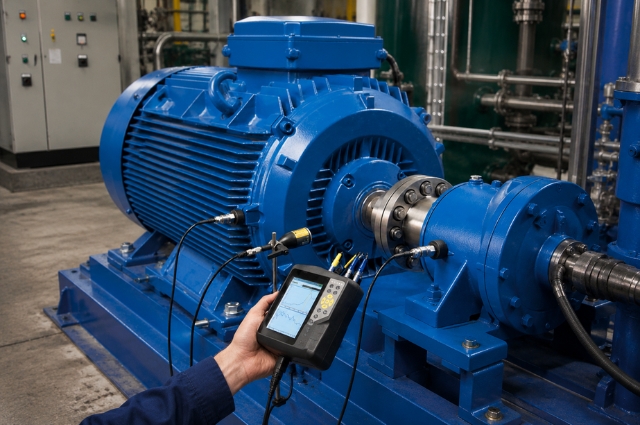
Our technicians mount precision accelerometers at designated measurement points on each motor housing to capture real-time vibration data under actual operating conditions. Using FFT spectrum analysis, we collect full frequency spectrum and waveform data that reveals the amplitude, phase measurement, and vibration signature of every motor in the inspection route. This diagnostic process identifies not only rotor imbalance but also bearing wear, looseness, misalignment, and resonance issues that visual inspection alone would never detect. We evaluate severity against ISO 10816 and ISO 7919 standards to determine whether each motor falls within acceptable operating thresholds or requires immediate correction.
Balancing Correction and Post-Inspection Documentation
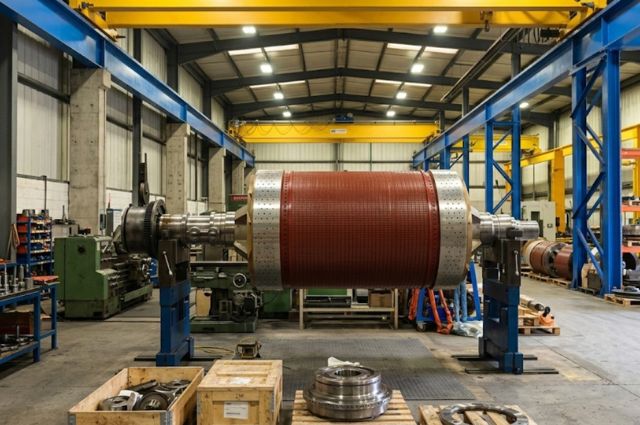
When our inspection identifies motors requiring correction, our technicians perform onsite dynamic balancing using trial weight placement, influence coefficient calculation, and precise adjustment through weight addition or weight removal to bring the rotor within the required ISO 1940 balance quality grade — G2.5 for standard electric motors or G1.0 for high-speed and precision applications. Every inspected motor receives a detailed report with before-and-after vibration data, the balance grade achieved, residual unbalance measurements, and tailored maintenance recommendations. This traceable documentation satisfies IATF 16949 and AS9100 audit requirements and establishes a verified baseline for future trend comparison.
Signs Your Detroit Facility Should Schedule a Motor Balancing Inspection Now
Recognizing the warning signs early gives your maintenance team the opportunity to schedule corrections before imbalance progresses into equipment failure. Physical symptoms include excessive vibration felt on the motor housing or mounting structure, unusual noise patterns such as grinding, humming, or rattling during operation, elevated bearing temperatures detected during routine rounds, visible shaft runout, and inconsistent product quality in machining operations where spindle vibration affects surface finish. Any motor running rough after rewinding or major repair is also signaling that the rotor’s mass distribution has changed and needs professional evaluation before the imbalance causes secondary damage.
Operational indicators are equally important. Rising energy consumption on specific motor circuits without corresponding changes in load suggests the motor is working against increased mechanical resistance caused by imbalance. Increasing frequency of bearing replacements on the same motor points to a recurring vibration source that part swaps alone will never resolve. Motors approaching or exceeding acceptable vibration thresholds on handheld meters during maintenance rounds are progressing toward failure with every operating hour. Any single symptom warrants scheduling professional vibration analysis, and multiple symptoms appearing together indicate that imbalance has been developing unchecked and correction should not be delayed further.
Scheduled Inspection Programs Tailored to Your Facility’s Needs
We design every inspection program around your facility’s specific equipment inventory, production criticality, operating environment, and maintenance objectives. No two Detroit manufacturing operations are identical, and your monitoring schedule should reflect the actual risk profile of your motor fleet.
Monthly, Quarterly, and Annual Vibration Monitoring Routes
Monthly vibration monitoring routes are designed for facilities operating high-criticality motors where failure carries immediate production consequences — automotive assembly lines, aerospace machining centers, and continuous-process manufacturing where a single motor shutdown halts the entire operation. Quarterly inspections suit most standard manufacturing environments where trending data across three-month intervals provides adequate early warning of developing imbalance. Annual comprehensive assessments work for facilities with lower motor counts or less demanding duty cycles. Each monitoring route covers every designated motor using consistent measurement points and procedures that enable accurate trend analysis and comparison across inspection cycles.
Baseline Analysis for New Motor Installations and Post-Repair Verification
Establishing baseline vibration data on every new motor installation and after every major repair or rewinding is essential for effective condition monitoring. Baseline analysis captures the motor’s vibration signature at its known-good condition, providing the reference point against which all future measurements are compared. Without this documented starting point, your maintenance team has no reliable way to determine whether a motor’s current vibration level represents normal operation or developing imbalance trending toward failure. We provide baseline analysis and post-repair verification as standard components of our scheduled inspection programs, ensuring that every motor entering service has documented reference conditions your team can monitor against.

How Scheduled Inspections Protect Bearings, Seals, and Equipment Life
Rotor imbalance generates centrifugal force that loads bearings asymmetrically during every revolution, accelerating wear on rolling elements, raceways, and lubrication far beyond what symmetrical loading would produce under the same operating hours. This is the leading mechanism behind premature bearing failure in industrial electric motors, and it begins causing measurable damage long before the vibration becomes obvious to operators on the production floor. The same vibration transmits through the shaft to degrade seals, creating lubricant leakage pathways and allowing contaminant entry that compounds bearing deterioration. Shafts, couplings, and motor housings absorb continuous vibration stress that fatigues materials and loosens mounting connections over time.
Scheduled balancing inspections interrupt this damage cycle at its earliest detectable stage, when a straightforward onsite correction restores smooth operation and effectively resets the wear clock on every component in the rotating assembly. The result is measurably extended bearing life, reduced seal replacement frequency, lower energy consumption from eliminated mechanical resistance, and significantly longer intervals between major motor overhauls. For Detroit facilities managing large motor inventories, these savings compound across every inspected asset — transforming your maintenance budget from a reactive expense center into a strategic investment in extended equipment life, energy efficiency, and sustained optimal performance that protects your production capacity year after year.
Industries Across Detroit and Southeast Michigan That Benefit From Scheduled Inspections
Scheduled motor balancing inspections deliver measurable value across every major industry operating in the Metro Detroit and Southeast Michigan region. In automotive manufacturing, assembly lines, Tier 1 suppliers, and OEMs in Detroit, Dearborn, and Warren depend on documented equipment health monitoring to maintain production continuity and satisfy IATF 16949 compliance requirements that demand traceable maintenance records. Aerospace operations require ISO G-1.0 balance grades and AS9100-compliant documentation that our inspection programs provide as standard. Steel and metal processing facilities operate heavy-duty motors in harsh environments where material buildup and thermal cycling accelerate imbalance faster than in clean manufacturing settings.
Food and beverage processing facilities benefit from documented inspection programs that satisfy hygiene and regulatory compliance standards requiring verifiable maintenance activity on production equipment. Water and wastewater treatment plants, power generation facilities, plastics and chemical processing operations, and HVAC commercial building systems throughout the region all operate critical motor-driven equipment where scheduled vibration monitoring prevents failures that carry operational, environmental, or safety consequences. Our inspection service area covers Detroit, Warren, Sterling Heights, Dearborn, Ann Arbor, Livonia, Troy, Southfield, and communities across Wayne County and Macomb County, with 24/7 emergency backup available if any scheduled inspection reveals a motor requiring immediate critical correction.
Our Inspection Equipment and ISO-Certified Methodology
Every scheduled inspection we perform uses the same professional-grade diagnostic instrumentation and rigorous methodology applied across all of our balancing services. Our inspection teams carry portable FFT analyzers for full frequency spectrum and waveform capture, precision accelerometers for real-time vibration measurement at exact locations on each motor housing, and phase measurement tools for identifying the angular position of rotor imbalance with the accuracy needed for first-pass correction. We rely on trusted industry-leading diagnostic equipment to deliver the measurement precision that automotive and aerospace quality environments demand from every maintenance partner touching their production equipment.
Our balancing corrections follow ISO 1940 and ISO 21940 quality grade standards, with every correction verified through post-balance vibration measurement confirming that the motor meets the required balance grade G2.5 or G1.0 specification before we close the job. Vibration severity on every inspected motor is evaluated against ISO 10816 and ISO 7919 benchmarks, providing standardized condition ratings your maintenance team can compare across equipment and over time. Every inspection report includes fully traceable data — vibration measurements, balance corrections, residual unbalance values, severity classifications, and maintenance recommendations — documented to a level that satisfies IATF 16949 and AS9100 compliance audits without requiring any additional paperwork from your quality team.
What to Expect When You Schedule Your First Inspection With Us
Scheduling your first motor balancing inspection with Dynamic Balancing Technologies begins with a free consultation where we learn about your facility’s motor inventory, production criticality, current maintenance practices, and specific concerns. We then develop a customized inspection proposal outlining the scope of work, monitoring schedule, measurement points, reporting format, and investment. There is no pressure to commit to a long-term program — many of our Detroit clients begin with a single facility-wide assessment to establish baseline conditions and evaluate the data before deciding on an ongoing monitoring frequency that fits their operation.
On inspection day, our technicians arrive at the scheduled time with all necessary equipment, conduct vibration measurements across every designated motor efficiently with minimal disruption to your production, perform any required balancing corrections on the spot, and deliver comprehensive reports before leaving your facility. Follow-up includes detailed analysis with vibration trending data, maintenance priority recommendations ranked by severity, and a proposed ongoing monitoring schedule based on what the initial inspection revealed. Transitioning from no inspection program to a structured vibration monitoring partnership is straightforward, and we handle the technical setup so your maintenance team can focus entirely on acting on the data rather than collecting it.
Frequently Asked Questions About Scheduling Motor Balancing Inspections in Detroit
How Often Should Our Facility Schedule Motor Balancing Inspections?
Frequency depends on motor criticality, operating environment, and duty cycle. Monthly vibration monitoring provides the earliest warning for high-criticality production motors. Quarterly inspections suit most standard manufacturing environments, while annual assessments work for lower motor counts. We design customized schedules based on your specific equipment profile and production requirements.
Do You Inspect All Motor Types and Sizes?
Yes. Our inspection programs cover AC motors, DC motors, 3 phase motors, high-speed motors, servo motors, and large industrial motors up to 500 HP. We also inspect spindle motors, pump motors, fan motors, compressor motors, conveyor motors, and any motor-driven rotating equipment your facility operates regardless of manufacturer or configuration.
Can Inspections Be Performed While Our Motors Are Running?
Vibration data collection is performed while motors operate at normal running speed — no shutdown is required for the diagnostic phase. If balancing correction is needed, the motor must be accessible for trial weight placement, which our technicians coordinate with your maintenance team to minimize production disruption during planned windows.
What Reporting and Documentation Do We Receive After Each Inspection?
Every inspection includes detailed reports with FFT vibration data, severity evaluation against ISO 10816 thresholds, before-and-after balance data for corrected motors, residual unbalance measurements, maintenance priority rankings, and trend comparison against previous inspections. All documentation is fully traceable and audit-ready for IATF 16949 and AS9100 compliance requirements.
How Long Does a Typical Motor Balancing Inspection Take?
Duration depends on the number of motors in the inspection route and whether corrections are needed. Vibration measurement on a single motor typically takes minutes, while a full balancing correction requires additional time depending on motor size and accessibility. We schedule inspections to align with your production windows and complete all work within the agreed timeframe.
Schedule Your Motor Balancing Inspection With Dynamic Balancing Technologies Today
Scheduling a proactive motor balancing inspection with Dynamic Balancing Technologies is the most effective step your Detroit facility can take to protect rotating equipment, reduce maintenance costs, and eliminate unplanned downtime. With over 33 years of diagnostic expertise, ISO-certified methodology, traceable documentation on every job, customized inspection programs for every facility size and industry, and 24/7 emergency backup when critical conditions are found, we deliver the complete inspection partnership your operation needs. Contact us today for a free consultation to take the first step toward a data-driven maintenance strategy.